

LOGAN, Utah (AP) — When it comes to working with visually impaired infants and their parents, perhaps nobody on the planet is as experienced, skillful and knowledgeable as Elizabeth Dennison.
This soft-spoken Mendon resident known to friends as “Bess” is not going to tell you that, the Herald Journal reported. The woman who 40 years ago this month started Utah’s internationally recognized and widely modeled Parent-Infant Program for the Blind and Visually Impaired likes to talk instead about how much she learns from the people she works to assist.
“I consider myself a cross-pollinator,” she says. “I learn so much from everybody I work with. I get something in one place, then I’m willing to share at the next place.”
The sharing began in the early 1980s when Dennison headed out in a station wagon with a master’s degree under her belt to identify visually impaired babies and toddlers around Utah and set up a network of special-education providers to serve the families of those children. The aim was to fill a critical gap in child-development services for the blind and visually impaired between birth and preschool, ages 1 to 3.
“In the first year of the new program, I traveled the state trying to find the babies needing help, and then we were looking at hiring people in those communities to bring to Ogden and train. Then they started working with the babies.” Dennison recalls. “Every three months I was traveling all over the state to make visits with those new interventionists, providing more on-the-job training and supervision, and we did special sessions with parents.”
Initially funded through a four-year federal grant, the program was the first of its kind in Utah. After gaining ongoing funding through the Utah Legislature, it has eventually become a model for programs everywhere, leading Dennison to divide her time between serving families and training others to do the same.
“One of the most awkward things I do in my position is to introduce myself as Bess’ boss because she is so remarkably knowledgeable,” said Karen Borg, a former member of the Logan Municipal Council who went on to direct the Parent-Infant Program through the Utah School for the Deaf and Blind in Ogden. “Bess is really a pioneer in the field. At first, that’s all there was was Bess, and through the years she has trained people in other states as well as other countries. She still does that. She goes out to places that are not as fortunate as Utah. Utah really is on the cutting edge of services for children with sensory loss, for vision and hearing.”
At the moment, Dennison is doing Zoom sessions through an outreach program run by Utah State University’s SKI-HI Institute, training a group of about 20 teachers in Tennessee and West Virginia who will launch those states’ first parent-infant programs. She also is working with eight local visually impaired infants and their families, some of the roughly 200 Utah families currently receiving service.
Though now at retirement age, Dennison has no plans to step away from her career. As she puts it, “I love what I do too much. I’m not ready to stop yet. I’ve pulled back on my hours some, but as long as my health holds out and I love what I’m doing, I think I’ll continue with a small caseload.”
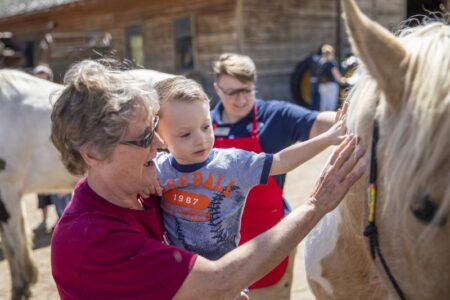
When Dennison and other professionals she calls “early interventionists” enter a home, it’s as much about working with parents as it is working with infants — passing on techniques the adults can use with their infants who are blind or visually impaired to acclimate them to the world around them.
One of the techniques is “routine-based learning,” which incorporates tactile exploration for the child into everyday activities like diaper-changing and feeding. This serves the dual purpose of aiding the baby’s development on a regular basis while making the teaching process less demanding and stressful for often-overworked parents.
“Bess is superb at that (balancing parental and infant needs),” Borg said. “She’s extremely humble. It’s amazing. It’s amazing.”
Dennison herself describes entering homes to provide assistance as “an honor” as opposed to a job, because among other things she gets to share in many tender moments within families.
“We are there to celebrate and enjoy their child with them and just help wherever we can,” she said. “It’s fun to be there and support the process and help them enjoy their child. They’re parents first, but they don’t have to be a constant teacher. Sometimes they have to be able to just enjoy their child.”
Dennison said her first few visits to a home are devoted to not only to assessing a child’s disabilities but gauging the parents’ situation and exploring what she can do “to make it a little bit easier for them to help their little ones and help them learn to do what all babies learn to do.”
Little ones. That’s what Dennison calls the infants she works with.
“With the little ones, you try to look at the positive, what they are able to do, and then build from there, not focus on what they aren’t able to do, and love them for where they are, accept them for where they are,” she said.
There was a time when many blind or deaf children were institutionalized, but in the years that Dennison has worked with visually impaired kids and their parents, the world has seen a massive shift in how such cases are handled. This is something her efforts have no doubt contributed to.
“When I first came to Utah in the early 1980s there were little children in the first couple of years of life whose families were being encouraged by other families and sometimes their own doctors to put them away in institutions,” Dennison said. “There was a big institution down around Provo somewhere that had a lot of little ones, because parents didn’t have the support they needed to help. That’s not the way it is anymore. These kids are staying home with their families who love them and care about them. The parents are getting the support they need.”
A key to effective intervention, she says, is catching a visual impairment early in a child’s life so adaptations can begin, but this is often missed because many children with limited vision also are born with other challenges.
For people of Dennison’s generation, the story of Helen Keller has served as a guidepost for what can be accomplished by a determined and savvy interventionist working with a child. Keller was born both deaf and blind, but with the help of teacher Anne Sullivan she grew up to become a world-renowned public speaker in the early 20th century.
The Keller-Sullivan story was dramatically portrayed in the 1962 movie “The Miracle Worker,” and that title also seems fitting in relation to Dennison’s pioneering work in the field.
Asked what she would most like the general public to know about early intervention programs like the one she hit the road to start in Utah four decades ago, Dennison stressed the importance of continued funding:
“Getting these services to children in the very beginning really helps them get a better start in life because in the years before we had these programs, some of these kids were getting ready to start preschool or maybe kindergarten and were oftentimes behind in their development. … Those little brains are the most malleable in the first few years of life, and it’s critical for us to impact their learning in a positive way and help families not to be alone in dealing with this.”