


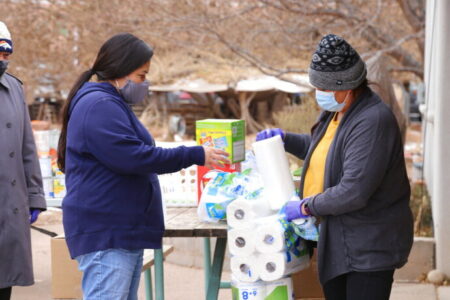
MOAB, Utah (AP) — On a cold, gray December morning, a handful of volunteers gathered in a small courtyard next to Moab’s youth garden.
Two Navajo women around the age of 40 and an older Navajo man counted out canned goods and hand sanitizer, then put them into reusable grocery bags lined up on the ground.
After filling 30 bags with corn for the elders, Ramirez ducked into a small kitchen next to the courtyard o help prepare blue corn mush for the other volunteers and talk about the group’s beginning.
There are around 500 Native people living in Grand County, according to the U.S. Census Bureau. But Ramirez said there wasn’t a good place for them to gather and share traditional foods and stories before she started the Full Circle Intertribal Center.
Before the pandemic hit, they held monthly dinners and a cooking circle for women and girls. But COVID-19 caused the group to shift its mission to taking care of Native elders, who carry the knowledge and traditions of their people.
Natives between age 60 and 80 are 2 to 3 times more likely to die from COVID-19, according to the Center for Disease Control. And the virus has killed hundreds of them on the nearby Navajo Nation.
“It’s just paramount for us to be able to take care of our relatives, you know, and I feel like that is something that has been forgotten,” Ramirez said. She said her organization also offers other services, like help for people affected by stalking or domestic violence.
Miyoshi Lee is on the group’s board, which is made up of four Native women. She took a break from packing bags outside to talk about the group’s impact.
Before the pandemic, she said the monthly community dinners helped Native youth learn from their elders.
“A lot of the time it’s not even really planned,” she said. “Like (when the kids are) handing a cup of tea (to an elder) they say, ‘Here’s your Navajo tea’ … Then the elders will teach them how to say it, where it came from, why it’s important and how it’s nourishing to our body.”
Lee said sharing that knowledge helps create a sense of kinship, which is the group’s mission. And delivering the COVID-19 supply bags to elders has helped keep those interactions going.
“Whenever I’m around my elders, I just feel really good,” she said. “And I feel super empowered because they have gained so much knowledge and they’re like our leaders to teach us the things that most generations are losing.”