

VERNAL, Utah-Monday, the finding of a prehistoric bug in southeastern Utah was published in Historical Biology and reported by researchers from Argentina and Utah.
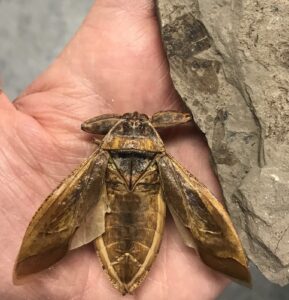
This insect has been named Morrisonnepa jurassica by paleontologists and ate snails, crustaceans, fish, amphibians and snakes.
It was discovered in southeastern Utah by paleontologists searching at the Late-Jurassic Age Morrison Formation in November 2017.
Most of its abdomen, two parts of a forewing and what may have been its head were preserved.
The same expedition also unearthed fossils in the area.
Researchers say this was only the second insect fossil to be unearthed in the area. The first one was a relative of crickets and grasshoppers in Colorado.
The new discovery was believed to be a member of the “true water bug” family, known as Nepomorpha, and related to the current Belostomatidae family, such as giant water bugs, sometimes known as “toe-biters.”
The insect discovered had something around its neck called a “stabbing organ,” which was likely used to impale prey.
It likely fed on similar animals to what is modern version does.
This discovery has been outlined by Maria Belen Lara of the Centro de Ecologia Aplicada del Litoral of Corrientes, Argentina, the lead author of the study, Dr. John Foster of the Utah Field House of Natural History State Park Museum, Dr. James Kirkland of the Utah Geological Survey and Thomas Howells of the Utah Field House of Natural History State Park Museum.
Earlier this year, researchers at the Natural History Museum of Utah, the National Park Service and the Bureau of Land Management had findings of a new Allosaurus species published in science journal, PeerJ in January.
This is known as the Allosaurus jimmadseni.
Researchers plan to return to the site sometime in the near future to search for more insect fossils.