



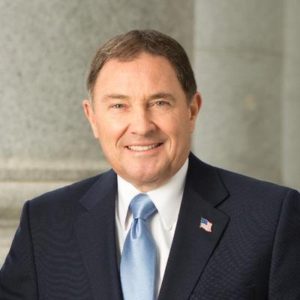
SALT LAKE CITY-Thursday, Utah, per the approval of Gov. Gary Herbert, made the transition from “orange” to “yellow” as was confirmed during a state Coronavirus Task Force briefing at the Utah State Capitol Building.
Maj. Gen. Jefferson S. Burton of the Utah National Guard confirmed that the transition from orange to yellow would occur Saturday May 16 with the exception of Wasatch, Summit and Grand counties as well as Salt Lake City and West Valley City.
Wasatch County Health Department Media Relations Coordinator Trudy Brereton said Wasatch County remains orange (moderate risk) because there are a few areas that remain at the orange level despite there being many portions of the county meeting much of the criteria for yellow, or low risk.
Brereton says data is moving in the right direction and, if the trend continues, the health department will make a request to Herbert’s office to change to yellow.
Next, remarks were made by Utah State Republican Sen. Dan Hemmert of Orem and University of Utah Health Department CEO Dr. Michael Good. Good reminded everyone to be aware of the at-risk population in the Beehive State and keeping them safe.
Utah state epidemiologist Dr. Angela C. Dunn then revealed the stats for COVID-19 in Utah over the course of the past 24 hours.
There are presently 6,749 positive tests for COVID-19 in the Beehive State. This is an increase of 129 cases from the previous day’s totals but represents a -59 net decrease. Presently, there have been 160,119 total tests administered for COVID-19 in Utah. This is an increase of 3,333 from the previous day. The total positive percentage in Utah dropped to 4.21 percent. 3.9 percent of Utahns tested for COVID-19 in the past 24 hours tested positive.
There are 558 hospitalizations in Utah for COVID-19, only an increase of 5 from the previous day’s totals. No new deaths in Utah were reported for COVID-19 in the past 24 hours.
Wasatch County presently has 188 COVID-19 cases, including three new cases in the past 24 hours. There is also a new hospitalization in Wasatch County, giving the county 9 hospitalizations from the disease. There remains only one death in Wasatch County from COVID-19. This occurred April 10.
Herbert, decked in a yellow tie in honor of the occasion, then expressed hope and optimism for the future.
He then unveiled the conditions of living under yellow or “low risk” in Utah.
Under yellow, Utahns may gather in groups of up to 50. Everyone must do their best to stay 6 feet away from others when outside of their homes.
Face coverings are to be worn when social distancing is difficult to maintain.
Symptom-checking must occur before engaging in close contact or team sports. However, this means that team sports are now allowed and swimming pools may resume operations. He suggested that at swimming pools, social distancing regulations may be relaxed.
Out-of-state travel is to be limited and spacing must be honored between immediate households.
Alternate schedules for smaller gatherings and stream services are the new norm for Utah.
Individuals in high-risk categories, including older adults and those with compromised immuno-systems, and those who care for them, are to still continue to follow “high-risk” protocols, regardless of whether their community is under an orange or yellow designation.
Herbert reported he will let a moratorium on evictions expire Friday. Herbert said this moratorium was designed to give the state a chance “to pause.” Now, however, he said, resources are available for renters that would assist them in paying their landlords.
Burton then returned to the podium to answer some questions. When asked about the 14-day incubation period for COVID-19 and how this makes Utah change to yellow, he responded: “We’re watching for trends and [are] being as objective as we can be based on data. If positive trends are detected, he said, it makes sense to move forward.
He continued, saying “many aspects roll into decision-making processes” and said known hot-spots need to be contained and “all decisions are data-driven.”
He then said this is a “day-by-day process.” He said that if any city wants to stay at a higher level, they can request a variance.
Burton said that if the variances are approved, progression may then be allowed to occur. If their requests are not approved, the reason for such being disallowed will be based on data.
Herbert then concluded his remarks, saying “responsibility is at the forefront.” He also confirmed that opportunities will be opened up for drivers education and that Utahns are no longer being asked to leave home only infrequently.
Herbert also mentioned that the briefings, which were once daily, will now be reduced to twice a week. Herbert confirmed he will be addressing the state weekly.