



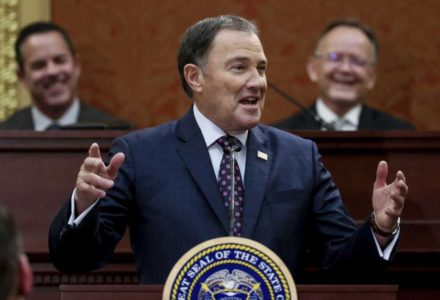
SALT LAKE CITY-Thursday, Utah Gov. Gary Herbert and state epidemiologist Dr. Angela C. Dunn addressed the media at the State Capitol Building for what proved to be the last daily briefing for the Beehive State during the COVID-19 pandemic.
Herbert started off his comments by alluding to a statement released Thursday morning concerning the expiration of vehicles at the end of the month.
This is because the lines at the DMV’s in Utah are too long, he said. In citing Utah law in this statement, Herbert confirmed he is authorized to suspend this expiration and he has chosen to do so until May 15.
Herbert also stated the Hurricane DMV will be open tomorrow with limited access while social distancing regulations are expected to be kept.
Herbert advised all travelers to be careful as they travel and with where they go and what they do.
Herbert, who sported an orange tie Thursday, symbolic of the Beehive State’s transition from “high risk” (red) to “moderate risk,” (orange) on Friday, reminded Utahns that they can now gather in groups of 20.
In doing so, he cautioned, no one should be exhibiting any symptoms prior to gatherings.
He stated gyms, salons and personal care establishments, as well as bars, can be opened with limited customers or users allowed inside.
Herbert confirmed, “we ought to wear masks to these establishments.”
Herbert also exhorted Utahns to change their countenances, stating there should be a collective positive attitude in the Beehive State, concerning innovations made to get things back to normal.
Herbert then said the briefings will be less frequent. He stated that they will likely occur three times a week, moving forward with Dunn providing updates on Utah’s statistics for COVID-19.
Herbert reminded Utahns to continue practicing social distancing and to wash hands frequently, saying “now is not the time to relax.”
Herbert, when taking questions from the media, said “I am not overly concerned,” when asked about people potentially misusing their newfound freedoms. He said the state will continue to monitor the data and that he is “cautiously optimistic.”
If necessary, he clarified, “we will quickly transition back to red,” if Utahns do not adhere to the standards asked of them under the moderate risk parameters and if a spike in cases occurs.
Herbert again lauded his state, saying that other governors have questioned him what Utah’s secret to success is in regard to combating COVID-19.
Dunn then spoke, confirming there are 4,672 positive tests for COVID-19 in the Beehive State. This is an increase of 177 positive tests from Tuesday-Wednesday and a net increase of 25 positive tests in the past 24 hours.
There have been 108,501 total tests administered for COVID-19 in Utah. This brings the positive test percentage up to 4.305 percent as it has increased every day since April 28.
2,723 Utahns were tested in the past 24 hours, which means 6.5 percent of Utahns tested Wednesday-Thursday had positive tests.
There are 390 hospitalizations in Utah from COVID-19. This is an increase of 7 from Tuesday-Wednesday and there is one new death, bringing the Beehive State’s total to 46.
Dunn confirmed this was a 60-year-old male in Salt Lake County who did not die at a long-term healthcare facility. Dunn said she is working on discovering the cause of the death.
Dunn also revealed strike teams will be employed in Utah to help the slow of the spread in hot spot locations. Dunn confirmed that long-term healthcare facilities are among those locations where strike forces will be used.
She confirmed these teams will consist of state officials, medical professionals and health professionals.
Dunn declined to identify where these hot spots are located but said that it’s up to local health departments to discern where they are in their respective areas.
Dunn concluded, saying “we rely on all Utahns to follow the guidelines. Everyone needs to take responsibility.
Wasatch County has one new case of COVID-19 from Tuesday-Wednesday and there remains 7 hospitalizations and one death in the county, which occurred April 10.