



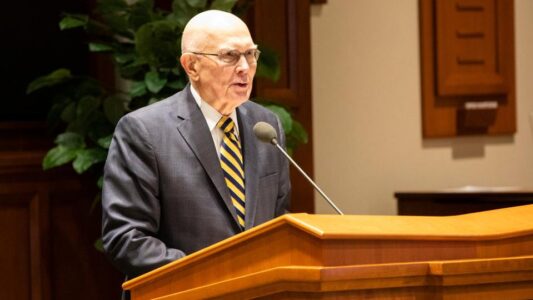
PROVO, Utah-Friday, President Dallin H. Oaks, the first counselor in the First Presidency of the Church of Jesus Christ of Latter-Day Saints, shared his experiences writing about the first president of the Church, Joseph Smith, during the Church History Symposium at the BYU Conference Center.
This year’s symposium is “Joseph-Smith themed” and Oaks spoke of how he delved into decades of research in studying Smith’s life.
Oaks’ address Friday featured his various writings on Smith, including a book, three articles in professional journals and an address at a scholarly conference in Illinois on the subject.
Oaks spoke glowingly of Smith’s character, saying he was especially “adored” by his contemporaries who “stood closest to him in Church leadership.”
Oaks cited the suppression of the Nauvoo Expositor among his talking points. This addressed a time when Smith, then the mayor of Nauvoo, carried out the order of the Nauvoo City Council in destroying the press June 10, 1844. Oaks, a prominent legal professional in various positions prior to his calling to the Quorum of Twelve Apostles of the Church in 1984, examined this from the legal perspective.
Oaks, in his studies, discovered modern criticism of the suppression of freedom of the press was rooted in the principle of freedom of speech and the press.
This is found in the 14th Amendment of the United States Constitution. This amendment was ratified two decades after the events in Nauvoo.
Therefore, Oaks called the assumption that the Nauvoo City Council committed a purportedly “illegal” action “not well founded.”
This led Oaks to declare that he is not fond of “the technique of presentism.” This process, which relies on current perspectives and culture to criticize actions of the past is unfounded, he asserted.
Oaks further stated “past actions should be judged by the laws and culture of their time.”
Oaks then explained his book, “Carthage Conspiracy,” which focuses on the trial of Smith’s accused assassins when he and his brother, Hyrum Smith, were murdered at Carthage Jail in Carthage, Ill. June 27, 1844.
Oaks manifested he received “divine help” when writing this book. He was able to successfully locate documents about the trial’s first defendant and later discovering an important manuscript of testimony from the trial at Carthage.
Oaks cited this as evidence that the Lord assists us when seeking His guidance and when we are sensitive to the Spirit’s promptings.
He then spoke of Smith’s bankruptcy and property at death. Incidentally, this explored the increasingly strained relationship between Joseph’s widow, Emma Smith, and his successor as President of the Church, Brigham Young.
Oaks explained the friction stemmed from the fact that “in fairness and equity,” these properties belonged to the Church. However, Emma Smith had a “clear legal right” to the property per Illinois law.
Oaks then spoke of his 2005 address before the Library of Congress at Washington DC, commemorating the 200th anniversary of Joseph Smith’s birth.
Oaks concluded his remarks by citing his legal history conference address in 2013 at Nauvoo.
His remarks that day concerned three failed legal attempts to extradite Smith from Illinois to face criminal charges in Missouri.
Oaks cited the words of Justin Butterfield, who at the time was the highest-ranking lawyer in Illinois and was representing Smith.
Butterfield confirmed that Smith is “an innocent and un-offending man.”