


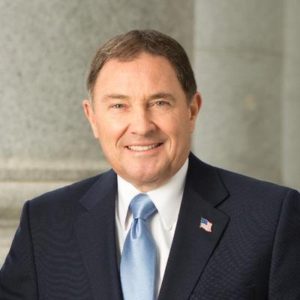
SALT LAKE CITY-Utah Governor Gary Herbert added a new branch to the Utah Coronavirus Task Force during the daily press briefing at the Utah State Capitol.
Herbert said he’s grateful for Utahns concerning the work they are doing in combating COVID-19. Herbert said the state’s plans “are working to slow the impact of the virus.”
He stated 501 businesses in the first round of bridge loans and 648 in the second round of bridge loans. He confirmed this is helping to keep 15,000+ jobs.
Herbert said small businesses that are hurting could still receive assistance via grants and loans.
Businesses, he continued, could see a check in the mail as early as tomorrow. This consists of $3.6 billion in loans.
Herbert then announced the new branch in the taskforce, the Utah Multicultural Commission.
This is to assist those who are facing barriers because of COVID-19. The Hispanic/Latino population and the Pacific Islander community have each been hit hard by the virus, he said.
Herbert said this subcommittee will include partners from government and business leaders of faith-based organizations and community advocates.
The co-chairs are Ze Min Xiao and Byron Russell who will promulgate this initiative throughout the Beehive State. The leader of this task force will be Nubia Pena.
Herbert said the Navajo Nation has been hit “particularly hard” by COVID-19. He stated that mobile testing sites have been dispatched to native nations.
The state has donated personal protective equipment and agricultural help for native tribes throughout Utah.
The public health information has now been translated into 18 languages (with five more soon to come) Herbert said.
Herbert continued, by confirming that the Navajo Mountain and Monument Valley areas of Navajo Nation are pushing out Public Health Emergency Preparedness funding to tribal programs and the Urban Indian Center of Salt Lake.
Funding has occurred for this initiative through the Utah Senate and the Utah House of Representatives, he said.
Agricultural help has come in the form of alfalfa and grain to the San Juan Southern Paiute Nation, Herbert said. Furthermore, he stated, personal protective equipment and food donations/hygiene material have been sent to them.
Russell was the next to speak. He said the subcommittee’s goal is to provide “basic needs” and “disseminate information to under-represented populations” in four prospective languages.
Pena reported that marginalized populations are facing struggles. Pena outlined the lack of correct information and resources for under-represented communities, such as a lack of Internet resources for many.
She confirmed there is a resource page for minorities and the organization has made a list of testing sites in Spanish.
The Multicultural Task Force, as it will be called, relies upon those who are on the “front lines to fill in the gaps” that the task force may not be seeing themselves.
Herbert then returned to the podium, saying that as the economy commences its reopening, “we cannot let minority groups fall through the cracks.”
He then said “jobs will be plentiful” once businesses are open.
Herbert confirmed that “we worry about all families” while Utah’s workforce services are trained to help all residents find employment.
Those in need of job assistance can call 1-801-538-1000 or visit jobs.utah.gov.
The state is doing its best to keep up with all information as swiftly as it can. Russell confirmed the task force has been in the works for the past six weeks.
Next, Utah state epidemiologist Dr. Angela Dunn spoke.
She confirmed there are now 3,612 positive tests in Utah from COVID-19. This is an increase of 167 positive tests from Wednesday’s total. Its is also an increase in net positive tests of 18 in the daily increase.
Dunn said 80,627 tests for COVID-19 have been administered and expressed optimism as the rate slipped to 4.47 percent, a decrease of -0.3 percent from Wednesday.
Dunn stated there are now 301 hospitalizations from the disease in Utah. This is an increase of 13 from Wednesday’s numbers. 35 deaths have occurred from COVID-19 in the Beehive State, an increase of one from Wednesday.
The death, she said, was over the age of 60 and a resident of Salt Lake County living in a long-term healthcare facility.
Dunn stated the Utah Department of Health is working with correctional facilities to help slow the spread of COVID-19 among the incarcerated.
This is a problem, she said, because 45 cases have occurred in correctional facilities.
Dunn concluded by saying county health departments are working to protect inmates and employees through isolation practice, testing and personal protective equipment.
The Utah coronavirus task force will again address the media Friday.