



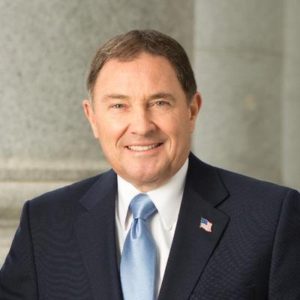
SALT LAKE CITY-Tuesday, Utah Governor Gary Herbert addressed the media at the State Capitol building as part of his series of daily briefings.
Herbert commenced his statements by saying materials are needed for additional testing. In remarks shared by United States president Donald Trump during his coronavirus task force briefings Monday, he said that states in need of supplies need to let the White House know about their needs.
Herbert, in follow-up comments, said “help is on the way,” although it is uncertain when exactly that will be.
Herbert then said it is one of the state’s hopes to mitigate factors leading to unemployment and cause employment to rise again.
Herbert then unveiled the biggest news of the day: the PPP, otherwise known as the “Paycheck Protection Program.”
Herbert proclaimed the importance of this declaration by confirming 90 percent of businesses in Utah are small businesses.
The PPP is specifically earmarked to assist these small businesses. Those who can benefit from the PPP include small businesses (anyone with 500 employees or less per Herbert’s definition), mom-and-pop shops and local franchisee restaurants/hotels, among others.
Herbert encouraged small businesses to reach out to their lenders for PPP loans. If small businesses do not have lenders, Herbert continued, a list of them can be found on the newly-devised Web site www.coronavirus.utah.gov/business.
The next speaker was Derek Miller, the president of the Salt Lake Chamber of Commerce. Miller reiterated many of Herbert’s comments about small businesses reaching out to achieve these PPP loans.
Miller further confirmed why the PPP is so important because for the time being, it is in the best interests of businesses to adhere to Herbert’s restrictions so that everyone can be safe.
Moving forward, however, Miller said businesses must swiftly apply for the PPP loans so that the necessary capital can be amassed so that everyone can pay their expenses and employees. Ultimately, Miller said, this can make the economy thrive again.
Miller said the ultimate plan is to create a state-made economic response plan.
This is outlined in the Utah Leads Together plan, the brainchild of discussions Herbert and Miller had with other members of the Salt Lake Chamber of Commerce last month.
Coordination has been entered into with the University of Utah’s Eccles School of Business as the university presents Tuesday and Friday seminars entitled: How To Save Your Business. These are conducted by former Utah Governor Mike Leavitt.
Miller also stated a list of federal programs is now available for businesses. He confirmed that rapid response teams comprised of 50 volunteers from 20 different Utah organizations have used their talents to assist some 600 small businesses in the Beehive State already.
In answering questions from the media, Herbert said he wants everyone tested but the state lacks the capability to do so.
As presently constituted, Herbert said, the capacity currently exists to conduct 3,000-4,000 tests daily in Utah. He reiterated his previous point that he wants to see up to 7,000 tests conducted per day.
Herbert also declared he wants Utah to come back as the No. 1 economy in the country again, just as it was before the pandemic struck.
Herbert again confirmed that “data guides our policy,” concerning questions about whether or not Utah would have a state-wide lock-down imposed by his authority.
Herbert then declared the first ray of hope the state has seen in many weeks. He said that there are some hopeful signs and that it is of utmost importance to understand what the transmission rate is.
As soon as the number of cases per day goes down, then the state can begin to loosen some of the restrictions that have been imposed.
Herbert said he likes where the state is with its hospitals and reiterated that “we need to get to the point where we can see reduction.”
The concluding speaker was Utah state epidemiologist Dr. Angela Dunn. Dunn confirmed that there are presently 34,647 total coronavirus cases in the state, including 148 hospitalized cases.
Dunn again reminded her audience that the state is not fixated on an individual day’s numbers, but rather 2-week trends.
Dunn confirmed that Utah’s 5 percent positive test rate remains consistent. This trend has been meticulously intact for the last 10 days.
Dunn, in echoing her comments from Monday, said the state treats every positive test like a true positive test and, in turn, every negative test like a true negative test.
Should a Utahn test positive, by law, she said, every such test must be reported to the health department.
When asked about Church of Jesus Christ of Latter-day Saints missionaries who have come into the country after returning from their missions and test positive, Dunn said the Utah Department of Health seeks to contact the patients and see when the symptoms started. In so doing, they can then try to identify all close contacts for those people.
Dunn concluded her comments by saying on Mondays and Tuesdays there are usually dips in testing. She suggested this may be because of less demand for tests during weekends. Dunn said there is also a 3-day lag in the negative tests coming in. This may possibly skew the numbers, she suggested.