



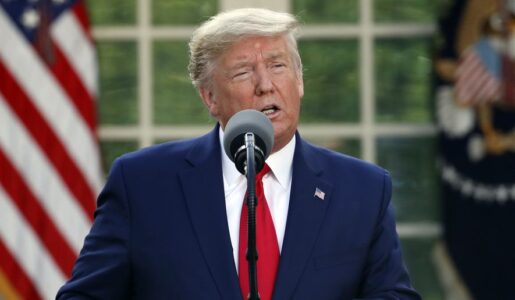
WASHINGTON-Thursday, United States President Donald Trump turned a mid-April evening into an august occasion for the country he presides over.
In speaking with select members of the White House Coronavirus task force at his side, Trump unveiled what he calls “Reopening America Again.”
Trump lauded the importance of mitigation and its successful execution, said “with mitigation, we’ve saved hundreds of thousands of lives.”
Trump further confirmed that “a national shutdown is not a sustainable long-term solution.”
Trump again lauded the United States’ robust testing system for COVID-19 and applauded the “heroism of our medical community and our citizens in a national endeavor.”
Trump then stated governors will take a phase and deliberated approach to opening their states, entitling this movement “reopening America.”
Trump continued, saying “The health of our citizens and the health of our economy go hand-in-hand. We must have a working economy. We want to get back to it quickly.”
Trump then implied that some states will open sooner than others. This was a topic he revisited several times during the Thursday briefing.
Trump then cited the vast importance of protecting the vulnerable in this country (senior citizens). Military and other groups will be allowed to “go about their business.” This will allow Americans to go back to work, he proclaimed, lauding his reopening America initiative.
Trump explained that governors will create tailored approaches to their states and the needs of those states.
He again spoke of “mitigation efforts” and how they will allow Americans to vanquish the virus should it recur in the fall as many experts have suggested it could.
To counteract this, Trump said at least 35 clinical trials will soon be conducted in hopes of a vaccine being successfully created.
Trump then denounced identity politics, saying “This is not about politics. This is about our country.”
Trump then explained that “instead of a blanket shutdown, we will pursue a focus on sheltering the highest-risk individuals.”
Trump concluded his initial remarks, saying that governors will be allowed to tailor their reopening process to meet the circumstances of their states.
Vice President Mike Pence then spoke for several moments. He cited that on March 11, the de facto start of the pandemic across the country, 23,588 COVID-19 tests were conducted. By March 18, this increased to 83,500 tests. By virtue of the partnerships entered into with Abbott Labs and other companies, 3.5 million tests had been conducted as of Thursday across the nation.
Pence said that 5 million tests are expected to have been conducted by April 30. The focus, he continued, is on the most vulnerable.
These tests can be used on a statewide or a county-by-county basis, predicated on what a governor deems to be best, Pence stated.
Federal guidelines will assist governors and state health officials in helping them plan the safest way to open their respective states’ economies, Pence said as he concluded.
White House Coronavirus Task Force coronavirus response coordinator Deborah Birx then outlined, via a series of slides, what the phases for reopening the country would look like.
Birx said that gate-keeping criteria would be used to enter into what she calls “Phase 1.”
Phase 1 consists of states looking at syndromic and respiratory illnesses. State epidemiologists and other public health officials will track cases. By federal regulations, there must be a downward trajectory for more than 14 days.
Birx said “we want every state to have a plan for the health of its critical employees. Nursing homes are also a big focus of the plan moving forward.”
She then explained Phase 2. This states that the vulnerable should continue to shelter-in-place. The public should continue to maximize social distancing, but gatherings of 50 individuals are permissible. Non-essential travel can resume.
Phase 3, she explained, will be a return to the “new normal.” This consists of continuing good hygiene practices and continuing distancing precautions. Asymptomatic surveillance, she continued, of vulnerable populations will be paramount under these circumstances.
National Institute of Allergy and Infectious Diseases Director, Dr. Anthony Fauci then spoke.
Fauci said “we are a large country with different dynamics. Some [states] have gone through a terrible ordeal and others have gotten through it rather lightly.”
Fauci then explained “gating in,” the step that will lead to Phase 1. He called this “the biggest hurdle” when entering into reopening phases. Some states will have already met the essential criteria and others will take longer.
Sports events are feasible to attend with crowds, Facui said although he cautioned that there may be certain setbacks. Fauci said that he envisions America “getting back to the new normal.”
Trump then returned to the podium and said there will soon be large areas of our country where COVID-19 will have run its course.
Trump, when asked about crowds returning to sports events, said that the spacing may start with spacing between two seats but gradually, perhaps by the autumn, there can be packed stadiums once again.
Trump was then asked about protesters in such places as Michigan, North Carolina and even St. George, Utah and how he felt about them breaking social distancing rules. He replied, saying “They are suffering. They want to get back. The American people have just been incredible.”
When asked about small business loans hitting their cap and being exhausted, Trump said they are exhausted because of their popularity. He said “it’s a good thing” as he continued. He cited that $250 billion requests have occurred to sustain small businesses. He expressed confidence in the Democrats going along with this, saying they “should approve quickly.”
When Trump was asked about what the federal government will do to help local governments/companies pay for the longer journey toward “the new normal,” he replied, “we’re going to be helping with testing. He said local governments will build local stockpiles and the federal stockpiles for much-needed equipment.”
Trump said there are 29 states who will be able to work on reopening soon, or 58 percent of the country. States like New York and New Jersey, he asserted, will take more time to get back to normal.
Birx then returned to the podium, stating that sentinel surveillance will be key to combating the virus. This entails things that have never been done to repel the flu. It will primarily focus on, she said, those who are the most vulnerable. People who are coming to the clinic for a routine checkup, she said, will be screened for COVID-19.
Fauci then returned to the podium for comments, expressing his beliefs that antibody tests and tests for the actual diagnosis of COVID-19 will get better, especially when the nation moves into the fall when it may possibly recur.
Trump then took questions again and when asked about opening things up without doing widespread testing, said, “we have capacity but there are states with very little cases or very little issues.”
When asked about milestones, such as Memorial Day and the 4th of July being reached and if they can be enjoyed as they traditionally have been, Trump said “I think we’re going very quickly now.” He stated his beliefs that there will be many states open with ‘nice surprises’ over the course of the next few days.
Trump said he wants states to come back when they’re ready and to do so safely as he concluded his Thursday remarks.
Fauci, as he concluded, said “the dominating drive of the plan to reopen America was the safety and health of the American people.”
To conclude the briefing, Birx said that every single lab needs to be assessed to see what is needed for testing. She confirmed that each governor and public health official knows where these tests are.