

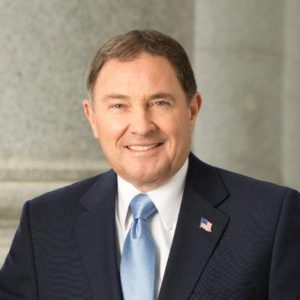
SALT LAKE CITY-Wednesday, Utah Gov. Gary Herbert and select members of the Utah Coronavirus Task Force spoke during the weekly briefing at the Utah State Capitol Building.
Herbert alluded to the special session of the Utah Legislature later this week wherein the budget, which has been negatively affected by COVID-19, will be addressed.
Herbert spoke of a deficit of $93 million in one-time funding. This also consists of $757 million in ongoing funding in general education funds.
Herbert exhorted Utahns to be optimistic that “we are on the road to recovery,” speaking in regard to the economy.
He said he also remains hopeful that a reduction of the current 9.7 percent employment rate in the Beehive State can further plummet.
Herbert confirmed that the state will “rebound and be stronger than before.”
He then proceeded to unveil the initial plans for Utah Leads Together: Volume 4.
Herbert called this “the foundation for recovery” and cited the need for Utahns currently out of work to get back to their jobs as soon as possible.
In speaking of the tenants of Utah Leads Together: Volume 4, Herbert said they consist of targeted assistance programs, which mirror the CARES Act out of Washington.
He stressed the importance of Utahns taking personal responsibility for their actions as he continued.
Herbert said the state must invest in construction and infrastructure to prepare for the future in order to “accommodate growth and prosperity.”
This concluded Herbert’s original remarks as he turned the time over to Sen. J. Stuart Adams of Layton, the Senator for Utah’s 22nd district.
Adams said the state will dip into its rainy day fund and said “I think we’re the only state in the nation increasing funding instead of cutting it.”
Brad Wilson of the Utah House of Representatives then spoke, saying “Utah has successfully flattened the curve” and is ready to turn to economic recovery.”
Wilson then stated that within the next 100 days, the Department of Workforce Services will start working with the unemployed to help them find work.
He continued, saying the Utah Economic Recovery grant program will take CARES Act funding to rebuild the economy.
Wilson said this grant money will go directly to businesses that have been heavily affected by COVID-19.
He said that grants received “must be spent by the end of the year.” Wilson suggested there could be difficult months on the horizon, but leaders are confident in where the Beehive State currently is in its progression.
Wilson then turned the time over to Derek Miller, the president/CEO of the Salt Lake Chamber and Downtown Alliance.
Miller said the new plan extends “hope and a serious playbook to rebuild Utah’s economy.”
Miller said there is a 250-day goal for Utahns to get their jobs back and that efforts will be made to connect people with new jobs in the state.
Next, Theresa Foxley, the chief executive officer of the Economic Development Corporation of Utah said the state is investing in new programs which will ensure prosperity for everyone.
Foxley said broadband can be used to address social inequities and she asked for housing bonds and other upgrades.
Herbert then returned to the podium to take questions about what had been discussed.
When asked about why he felt so strongly about proceeding with Utah Leads Together: Volume 4, Herbert said “a big concern with the pandemic was ensuring Utah hospitals aren’t overwhelmed.”
When asked about available ICU beds, Herbert said “we are concerned about the rising rate.”
Herbert exhorted Utahns to wear masks, saying “if you care about your neighbor, wear a mask.” Herbert continued, saying wearing a mask shows respect to others.
Herbert confirmed he has been tested for antibodies twice and concluded with optimism, saying “our best days are ahead of us.”
State epidemiologist Dr. Angela C. Dunn then gave some remarks and said this week’s infection rate in the Beehive State is down 4.7 percent from the previous week.
She also admonished everyone to wear masks and limit social contacts outside of the home.
The Wednesday COVID-19 stats for Utah confirm that there have been 15,349 cases of COVID-19 since statistics have been kept.
This is an increase of 407 cases in the past 24 hours as well as a net increase of 78 cases in the same span.
There have been 8,552 recovered cases of COVID-19 in Utah. This is an increase of 82 in the past 24 hours but a net decrease of 8 in that same span.
This dropped the overall recovery percentage in Utah to 55.7 percent of COVID-19 cases. There are presently 6,643 active cases of COVID-19 in the Beehive State. This is an increase of 321 active cases in the past 24 hours and a net increase of 84 active cases in the same span.
The current active case percentage is 44.2 percent of all COVID-19 cases.
There have been 278,692 total tests administered for COVID-19 in the Beehive State. This is an increase of 2,992 cases in the past 24 hours.
This caused the overall positive test percentage to increase to 5.5 percent. In the past 24 hours, the positive test percentage rose from 11.9 percent to 13.6 percent.
Since statistics have been kept, there have been 1,102 hospitalizations from COVID-19. This is an increase of 29 from Tuesday’s totals. However, there are presently only 147 current hospitalizations (Herbert alluded to this as one of the reasons he is confident in Utah Leads Together: Volume 4 being unveiled). This is an increase of four from Tuesday’s totals, but the current hospitalization percentage remains at 13.3 percent.
There was an increase of four deaths from Tuesday’s totals, bringing the net total to 149. This keeps Utah’s death rate, the lowest in the nation, below 1 percent at 0.097 percent.
In Wasatch County, there have been 362 cases of COVID-19 since statistics have been kept. This is an increase of six from Tuesday’s totals.
There have been 17 hospitalizations in Wasatch County since statistics have been kept. This represents a net increase of one in the past 24 hours.
There remain two deaths in Wasatch County from COVID-19. The most recent of the deaths occurred May 31.